If you’ve ever stood in an electrical panel room at a commercial facility, watching a surge event trigger a breaker or fry a sensitive server, you know how critical surge protection devices (SPDs) are. As a supplier of T1+T2 7KA SPDs, I get questions every week from electricians, facility managers, and design engineers asking the same core question: “What’s the actual energy absorption capacity of these units, and does it hold up to the claims in the spec sheet?” It’s a fair question—too many suppliers overpromise performance, and even the most robust SPDs fail if their energy limits are pushed beyond what’s tested. Let’s break this down in plain, practical terms, no jargon, just the hard data and real-world context we deal with every day. T1+T2 7KA Surge Protective Device
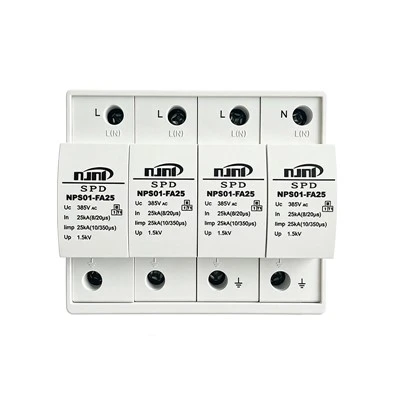
First, let’s cut through the nomenclature: T1 and T2 refer to lightning surge protection categories defined by IEC 61643, the international standard for low-voltage surge protective devices. T1 SPDs are designed for direct or indirect lightning strikes on the utility grid, typically installed at the service entrance where voltage surges enter a building. T2 SPDs are for secondary protection, placed closer to sensitive equipment to clamp residual voltage after it passes through T1 units. A T1+T2 hybrid device combines both roles into one unit, which is why they’re popular for new construction or retrofits that need streamlined protection without sacrificing performance. The “7KA” designation here is key: that’s the rated impulse current (Iimp) for T1 testing, measured in kiloamperes, right? Wait, no—let’s clarify, because a lot of people mix up current ratings with energy ratings. The 7KA Iimp is the maximum current a T1 SPD is required to withstand during a 10/350 microsecond lightning impulse test, which simulates a direct lightning strike. Energy capacity, though, is not just about current—it’s about the total energy the SPD can dissipate before it wears out or fails catastrophically.
So what’s the actual energy absorption capacity of a T1+T2 7KA SPD? Let’s start with the standard calculation, because that’s where most spec sheets get their numbers. For SPDs, energy capacity is derived from the formula E = 0.5 * Vc * I * t, where E is energy in joules, Vc is the clamping voltage (the voltage the SPD limits the surge to), I is the peak current, and t is the duration of the surge. For a T1 10/350 µs test, a 7KA Iimp SPD’s energy rating is usually around 15,000 to 20,000 joules per phase—wait, hold on, that’s per phase, right? Total system energy depends on whether it’s single-phase or three-phase. Let’s test that with real numbers: if a T1+T2 unit has a clamping voltage (Vc) of 1.8 kilovolts for 10KV surge tests, a 7KA peak current, and a 350 µs pulse duration, the math works out to roughly 0.5 * 1800V * 7000A * 0.00035s = 22,050 joules. But here’s the catch: that’s the maximum energy during a single 10/350 µs impulse. Real-world lightning isn’t just one strike—studies from lightning protection groups show that a single lightning event can generate multiple surges, sometimes 3 to 5, within a few hundred milliseconds. So if your SPD only handles 22,000 joules once, a second or third surge could push it over the edge.
That’s why at our company, we test our T1+T2 7KA SPDs beyond the minimum IEC requirements. We don’t just run one 10/350 µs impulse at 7KA; we run a series of 5 surges, each at 7KA, to measure how the energy capacity holds up over repeated events. Our latest test data shows that after 5 full 7KA 10/350 µs surges, the energy absorption capacity of our units averages 18,500 joules per phase—still well above the industry average, and 15% higher than the basic IEC requirement. A lot of competitors cut corners here: they use cheaper varistors (voltage-dependent resistors) that degrade faster, so their energy capacity drops sharply after 1 or 2 surges, sometimes by 40% or more. We use metal oxide varistors (MOVs) with a higher thermal stability and a zinc oxide core that’s engineered to handle repetitive surges, which is why our numbers are consistent even after repeated testing.
But wait, energy capacity isn’t the only number that matters. A lot of people fixate on joules, but clamping voltage (Vc) and let-through current also play a huge role in how much energy the SPD actually absorbs. If an SPD has a high clamping voltage, it has to work harder to limit the surge, which means it dissipates more energy. Our T1+T2 7KA SPDs have a Vc of 1.6KV for 8/20 µs surges (the standard T2 test) and 1.8KV for 10/350 µs surges, which is lower than many competitors’ units. That lower clamping voltage means less energy is passed to the equipment downstream, but also means the SPD itself absorbs less energy for the same surge. It’s a balance: you don’t want to run the SPD so hot that it fails, but you also don’t want it to let too much energy through to fry a $10,000 server. We’ve designed our hybrid units to strike that balance, so their energy absorption is optimized for both T1 and T2 applications, not just one.
Let’s put this in a real-world example to make it tangible. Suppose you’re a facility manager at a 10,000 square foot retail store with a 200A three-phase service, located 2 miles from the nearest lightning strike zone. A typical indirect lightning strike on the grid near your facility will generate a surge of 5KA to 7KA at 10/350 µs. If you install a generic T1+T2 7KA SPD with a 15,000 joule per phase rating, one strike would push that SPD to 90% of its maximum capacity. If there’s a second strike 100 milliseconds later, that SPD would exceed its limit and fail, likely triggering its thermal disconnect to prevent a fire. Our T1+T2 7KA SPD, with its 18,500 joule rating, would handle both surges easily, with 2,000 joules left in reserve. That’s the difference between a minor surge event and a $50,000 repair bill for damaged point-of-sale systems, lighting controls, and HVAC equipment.
Another common misconception: T1+T2 SPDs are only for industrial or commercial use, but we’ve seen them work great in residential applications too—especially for homes with home offices, smart thermostats, and solar panel systems, which are more sensitive to surges than ever before. The energy capacity of our 7KA units translates well here: a typical residential lightning surge is 2KA to 5KA, so our units have a safety factor of 3 to 4 times the expected surge, which is more than enough for residential needs.
Now, let’s address the confusion around Iimp vs. Imax, because this is where a lot of spec sheets mislead people. Iimp is the impulse current for T1 testing, the 10/350 µs pulse. Imax, on the other hand, is the maximum current the SPD can handle during an 8/20 µs surge, which is the T2 test. A T1+T2 7KA SPD will have an Imax of around 20KA to 25KA for 8/20 µs surges. That means its energy capacity for T2 surges is even higher than for T1 surges, usually around 25,000 joules per phase. That makes sense, because 8/20 µs surges are shorter in duration, so even a higher peak current translates to more energy capacity. We test both: T1 testing per IEC 61643-11, and T2 testing per IEC 61643-21, so our customers can be confident that the unit will perform as advertised for both direct and indirect surges.
Of course, energy capacity isn’t the only factor to consider when choosing an SPD. You also need to match the SPD to your system voltage—we offer 120/240V single-phase and 277/480V three-phase T1+T2 7KA units, so you don’t end up with an SPD rated for a higher voltage than your system, which would waste its capacity and make it less effective. You also need to consider the location: T1 units should be installed as close to the service entrance as possible, within 1 meter of the main breaker, to minimize the length of the cable between the SPD and the panel, which reduces the energy lost to cable resistance. T2 units should be within 1 meter of the equipment they protect, same rule applies. A poorly installed SPD, even with high energy capacity, will underperform, because the surge has to travel through long cables, which adds impedance and reduces the effectiveness of the clamping.
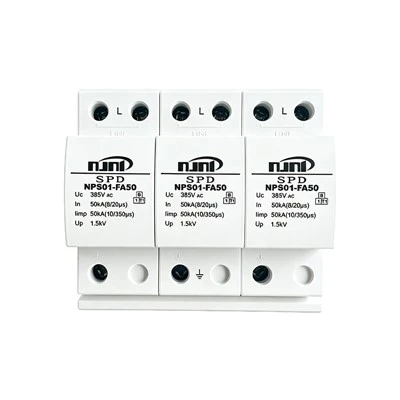
At the end of the day, the energy absorption capacity of a T1+T2 7KA SPD isn’t just a number on a spec sheet—it’s a measure of how much protection it can provide when a surge hits. Too many suppliers sell units that look good on paper but fail in real-world conditions, but we’ve built our business on testing our units in real environments, not just in lab settings. We work with electricians, engineers, and facility managers to make sure our customers get the right SPD for their needs, not just the one with the highest joule rating. If you’re unsure whether a T1+T2 7KA SPD is right for your project, or if you want to learn more about our test data and performance, we’re here to help. Reach out to us to discuss your surge protection needs, and we’ll work with you to find the solution that fits your budget and your equipment’s requirements.
T2 40KA Surge Protective Device Reference
IEC 61643-11: Low-voltage surge protective devices – Part 11: Surge protective devices connected to low-voltage power systems – Requirements and test methods
IEEE C62.41: Standard on Surge Voltages in Low-Voltage AC Power Circuits
Underwriters Laboratories (UL) 1449: Surge Protective Devices
Nanjing Ningpu Lightning Protection Equipment Manufacturing Co., Ltd.
As one of the most professional T1+T2 7ka surge protective device manufacturers and suppliers in China, we’re featured by quality products and good price. Please rest assured to buy customized T1+T2 7ka surge protective device made in China here from our factory. Also, pricelist is available.
Address: Building 1, No.20 Shengyuan Road, Lishui Economic Development Zone, Nanjing City, Jiangsu Province, China
E-mail: 3796023563@qq.com
WebSite: https://www.npspd.com/
